
Baryton
Barock Baryton nach Stadlmann


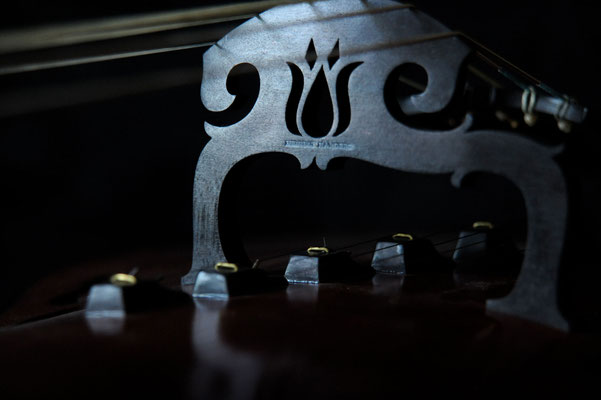


nach Stadlmann, Wien, 1732 + 1750
Als Vorlage für meinen Ersten Baryton benutzte ich das Instrument von Prinz Esterhazy, welches 1750 von Johann Joseph Stadlmann gebaut wurde. Das Original befindet sich in Budapest und ist sehr reich verziert. Zum Beispiel ist der Boden aus drei Teilen mit einer gewellten Fuge und die Ränder sind an allen nur denkbaren Kanten mit abwechselnden Ebenholz und Elfenbein belegt.
Original 7 Spielsaiten und 10 Resonanzsaiten, Saitenlänge ca. 63,5 cm.
Auf den Fotos ist meine Version des Daniel Achatius Stadlmann Baritons von 1732, welcher im KHM in Wien zu sehen ist. Für die Zargen und den Boden habe ich wunderschön geflammte Walnuss benutzt. Saitenlänge ca. 65 cm, hier mit 9 bzw. 11 Metallsaiten.
Der Besitzer meines ersten Barton's schreibt zu seinem Instrument:
'It is my great pleasure to play a baryton made by Henner Harders. This instrument speaks very light and brisk, has a noble sound and a good characteristic resonance. Perfection and accuracy of carvings - 'real viol maker's masterpiece' - this is not only my opinion, but also that of many musicians in Poland'.
Kazimierz Gruszczyñski - founder and leader of The Polish Baryton Trio
As a player, I have been particularly impressed by the instrument’s responsiveness and resonance. It has a distinctive sound that is beautifully silvery, complex and yet clear, particularly in the register supported by the sympathetic strings, and having given numerous concerts in many different venues, I have found that it projects remarkably well, even in larger spaces. Despite the potential complexity of the baryton as an instrument, the set-up allows this baryton to be played with ease, with the left hand able to reach all wire strings comfortably (even without a large hand), alongside all the other hallmarks of an excellent set-up one would expect from such a skilled luthier, and I have found the tuning to be very stable.
Above all, it has been a genuine joy to play, and its sound and work-of-art appearance have been widely admired by audiences and colleagues alike.
Fotos 1-5: Roland Scheikowski



Violworks - Henner Harders, Susanne Küster
Mansfelder Straße 48 | D-16949 Putlitz / Mansfeld
phone/fax: +49 (0)33981 505434 | e-mail: info(at)violworks.com